auto-AGENTS™ RSI: governed recursive self-improvement, running in production
Most enterprise AI stops learning the moment it is deployed. The model ships, the prompts freeze, and every improvement after that is a person reading transcripts and editing by hand.
We think deployment is where learning should begin.
For the past several months we have been running recursive self-improvement in production with several of our customers. This post covers what it is, what it did in two live deployments, and where the human stays in control. The full walkthrough is in the video below.
An AI agent is more than a model
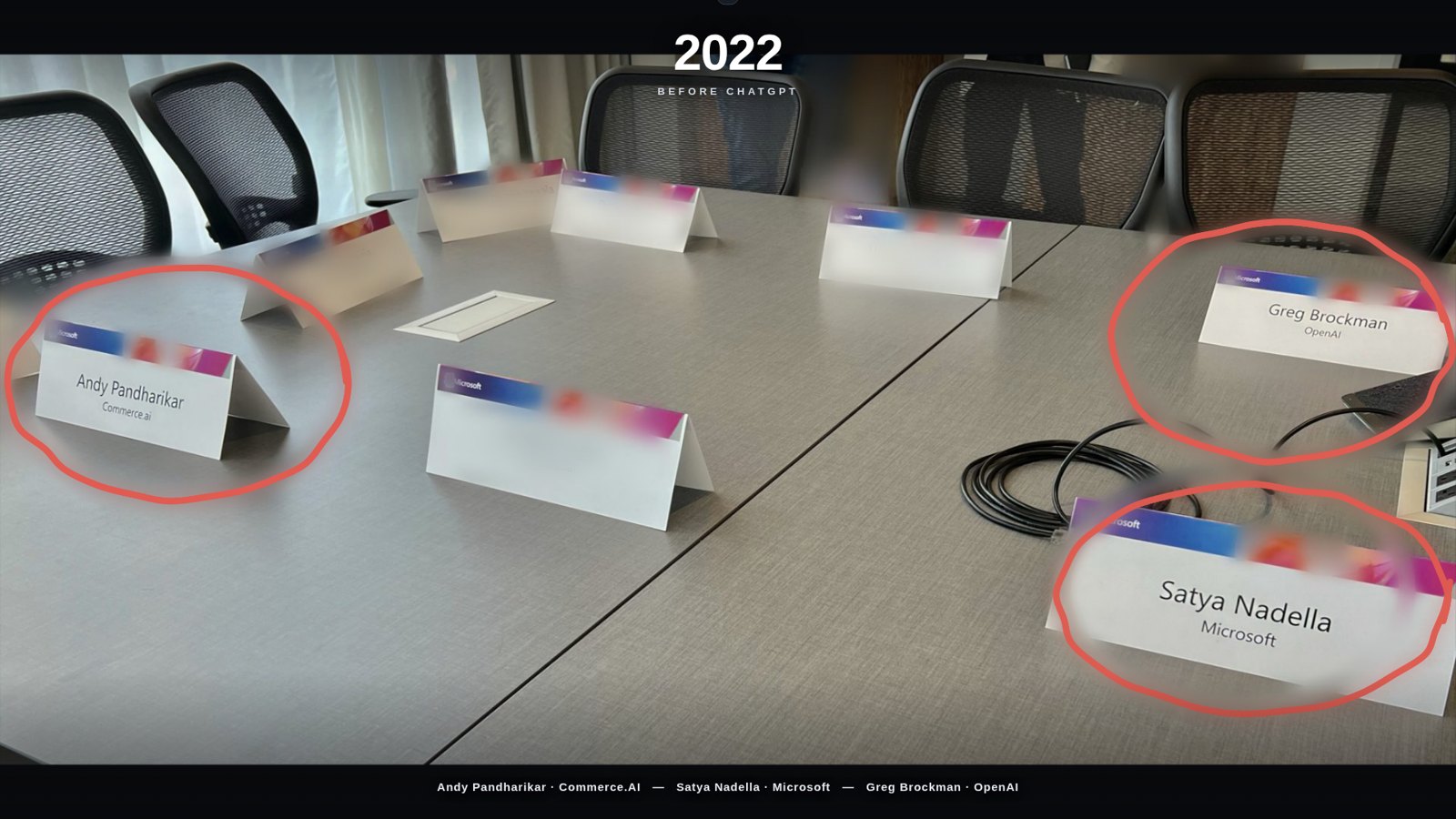
An AI agent is a model, the prompts that direct it, the tools it can use, and the memory it carries — all inside one boundary. The model provides the capability. Everything around it decides whether the work actually gets done correctly.
In the early days, every improvement to that boundary was manual. A person found the problem and edited the AI agent by hand: a new prompt version, a new tool, reshaped memory. The model never changed; the boundary around it did. It worked, but it did not scale.
So we governed it, and then we automated it.
The loop
auto-AGENTS™ RSI turns production evidence into a verified, customer-approved successor AI agent — and then improves the machinery that creates the next one.
Observe → Diagnose → Propose → Approve → Release → Measure → Repeat.
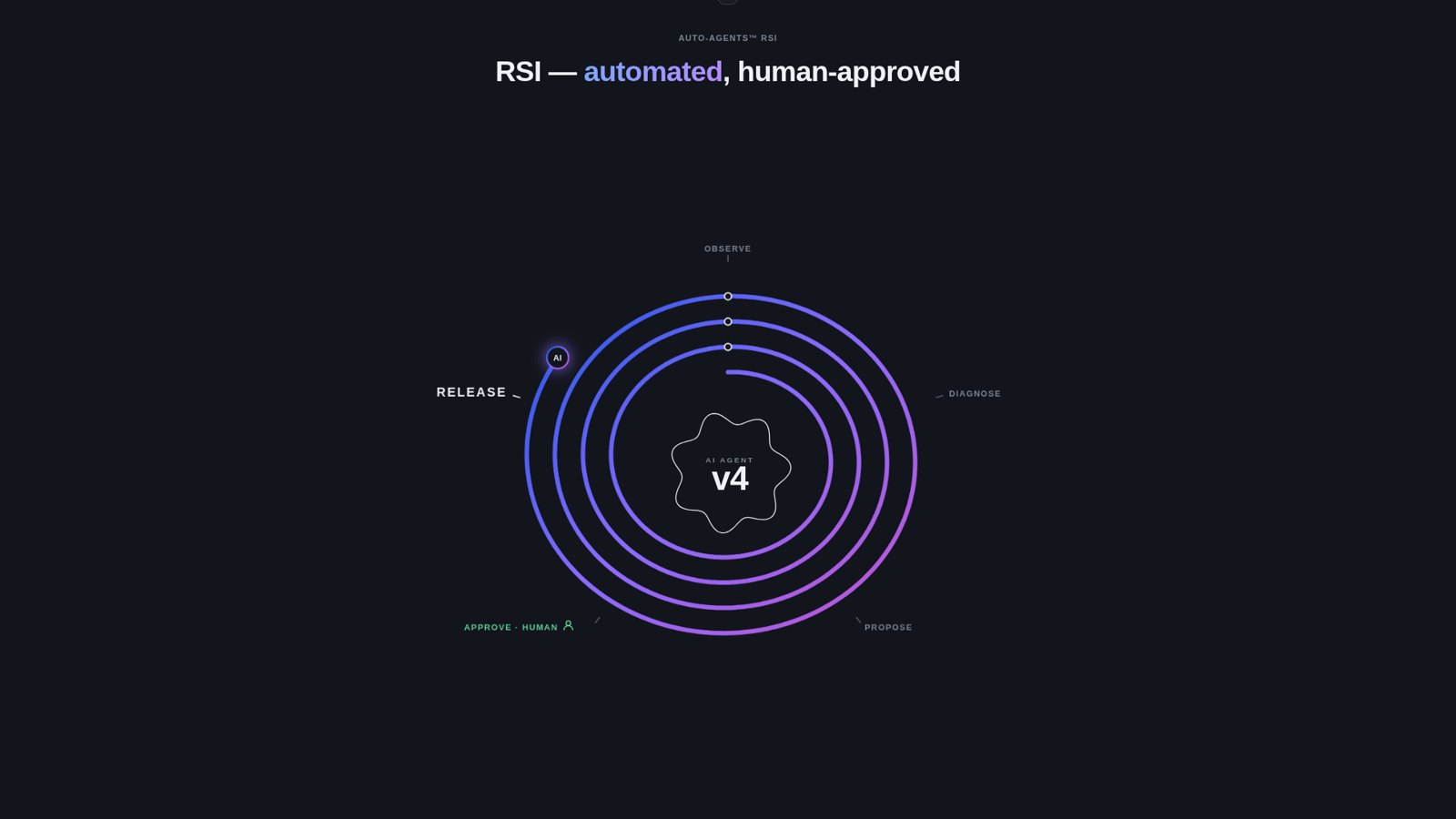
The approval step never leaves human hands. Every RSI loop runs inside a single customer's environment: their conversations remain their conversations, their policies remain their policies, and their operational memory, evaluations, approvals and successor versions stay specific to their deployment.
Case one: a missed opportunity nobody was looking for

An anonymized telecommunications deployment, processing more than 50,000 calls. The AI voice agent had a narrow job — work out whether the caller wanted Sales or Support, and transfer them to the right team.
The dashboard looked healthy. Thousands of completed conversations, Auto QA scores in the nineties, nothing obviously wrong. That is exactly why nobody was looking.
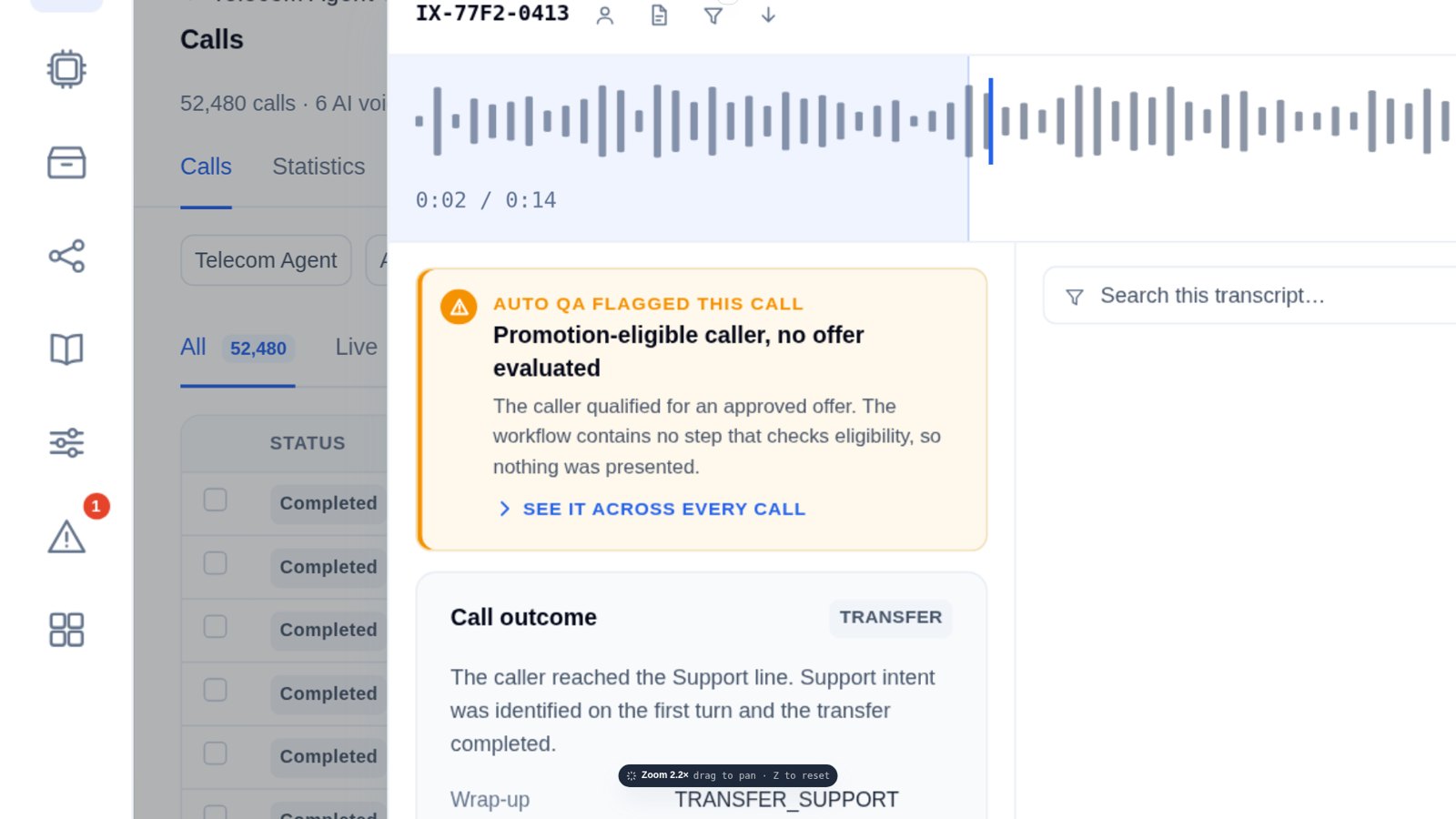
Auto QA found something the workflow could never act on: callers who were eligible for an approved promotion were being transferred straight to Support, and the workflow contained no step that could evaluate that opportunity. One call would be noise. The same pattern appeared across thousands.
The system prepared one bounded proposal — for an eligible caller, present one customer-approved offer before completing the requested Support transfer — and defined its own limits: preserve the Support request, never block the transfer, one approved offer only, honour an immediate decline, keep the whole interaction auditable. It ran the evaluation in front of the customer: intent accuracy, transfer preservation, approved language, latency, edge cases.
Then it stopped, because it cannot approve its own material change.
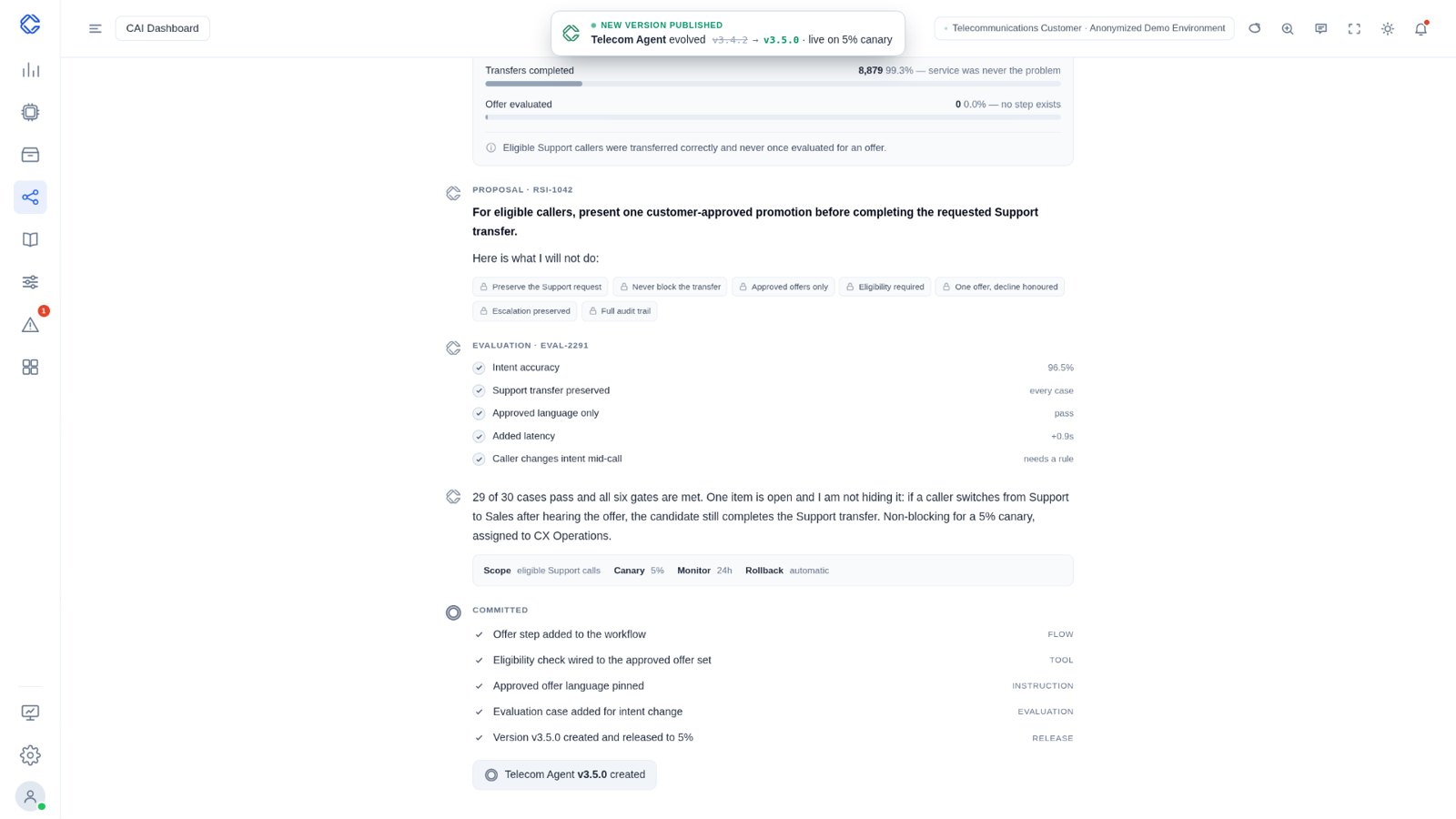
The customer reviewed the evidence and approved. That approval created a new versioned successor AI voice agent, which entered a controlled 5% canary and was opened up after monitoring held.
The reported result: a 4% sales uplift across a program processing more than 50,000 calls. The change itself was small and precise — one eligibility check and one offer added to the call, with the same transfer still completing at the end.
- 4%Reported sales uplift
- 50,000+Calls in the program
- 1Eligibility check added
- HumanApproves the change
Case two: when the model route fails
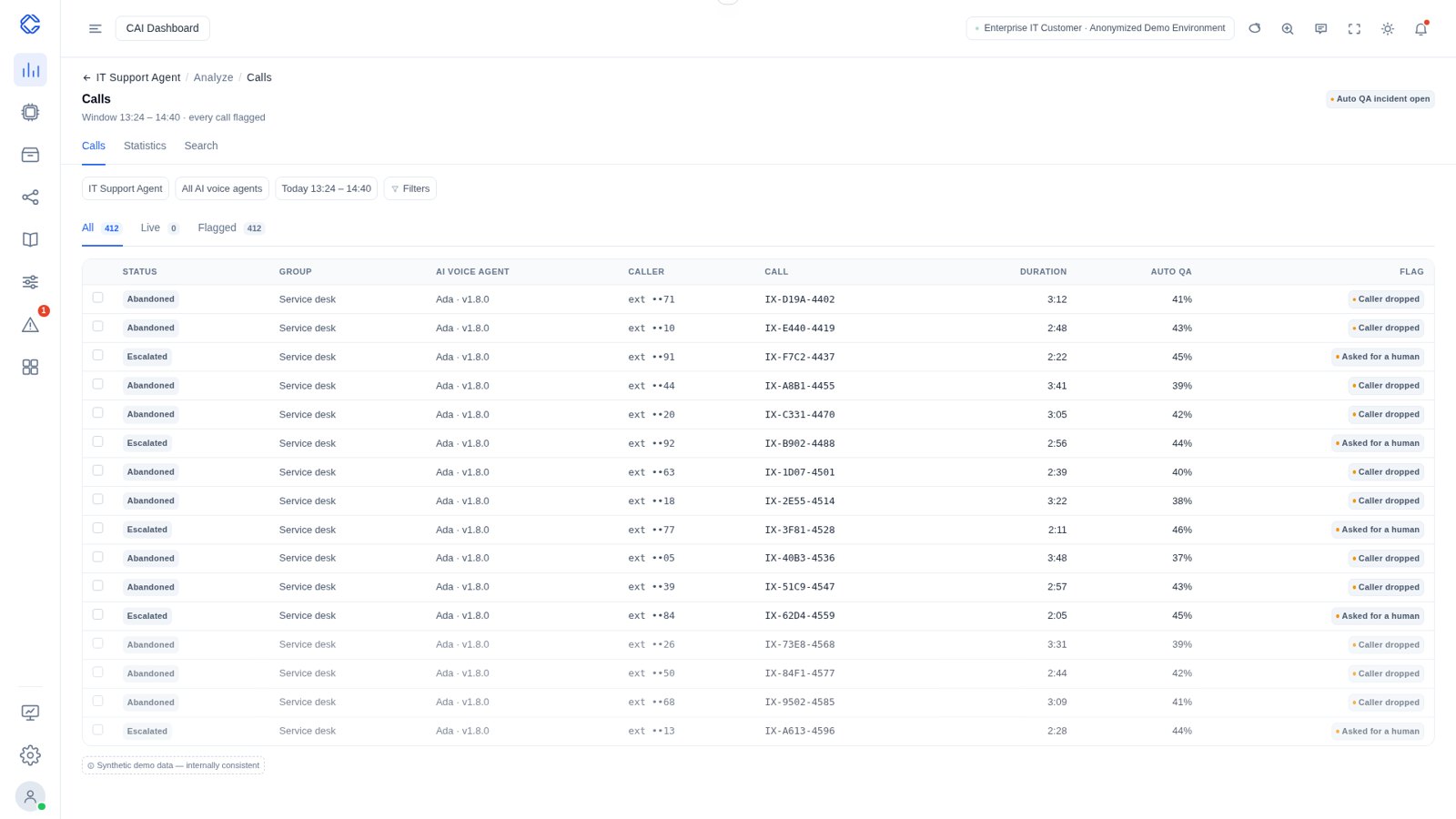
The second deployment was an internal IT service desk, and the problem was nothing like a missed offer.
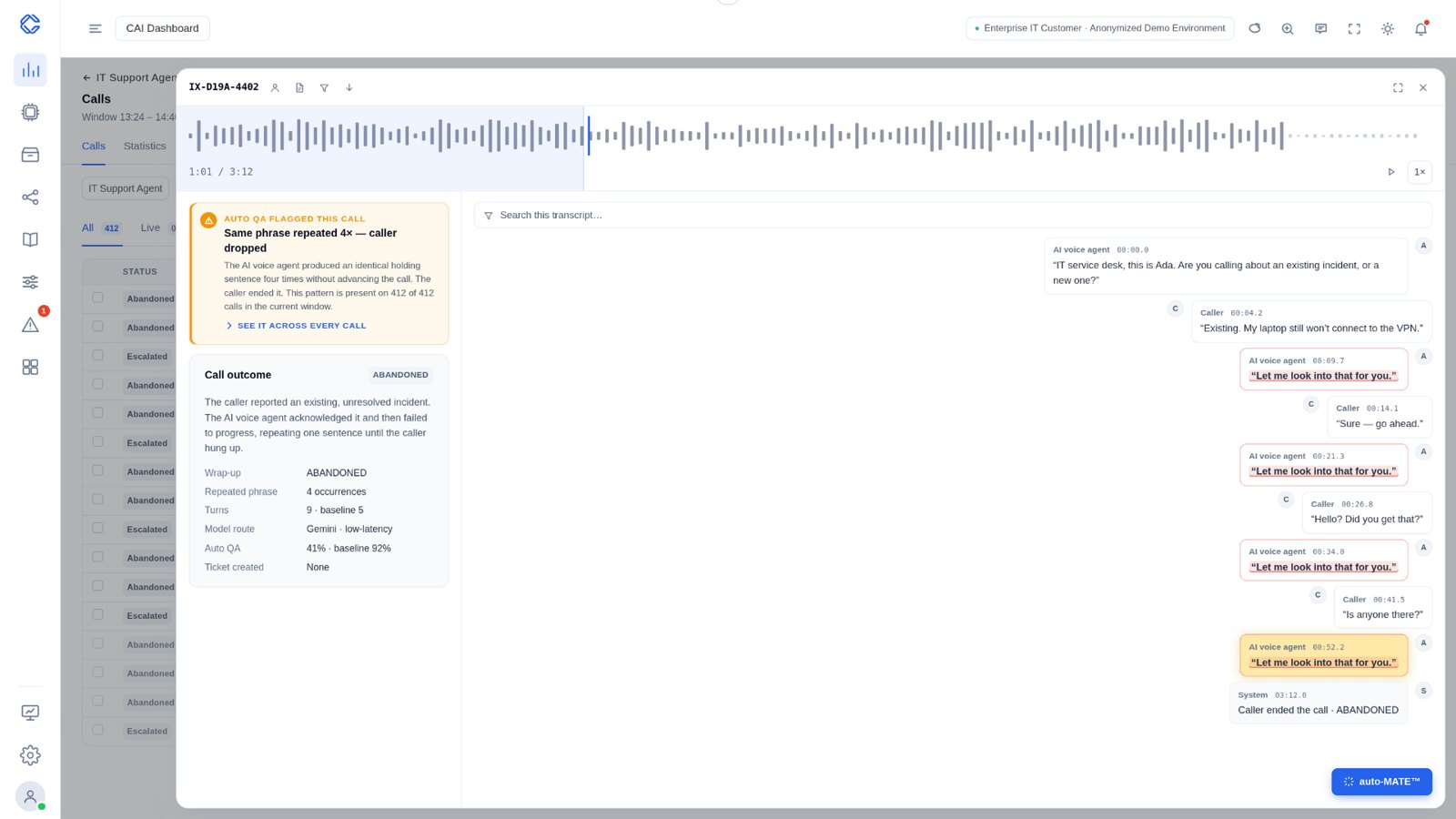
Auto QA scores had fallen sharply, interactions were being flagged, and callers were abandoning conversations. Inside a single call the pattern was obvious: the AI voice agent asked whether the caller had an existing incident or a new one, the caller answered — and then the AI voice agent repeated the same sentence. Again. And again. The conversation stopped progressing and the caller hung up.
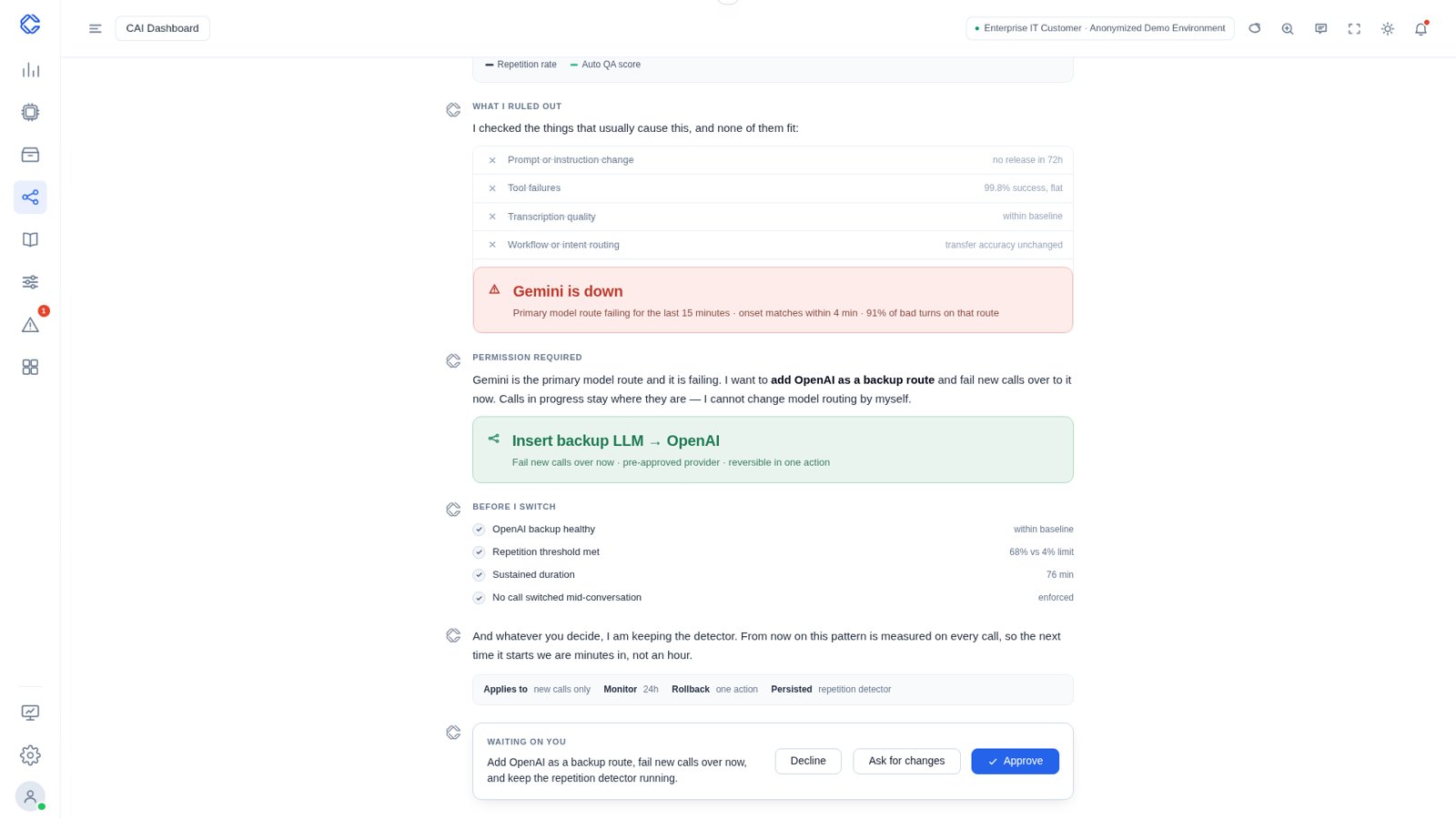
The system ruled out the usual causes in front of the operator: no prompt or instruction release, tools healthy, transcription within baseline, workflow and intent routing unchanged. What remained was the model route — the primary Gemini service had become unavailable, and conversations on that route were no longer progressing.
The proposal was operational, not conversational: add OpenAI as a backup route and fail new conversations over now, while calls in progress stayed where they were. Again, it did not change routing policy on its own. It presented the evidence and asked.
After approval, new conversations moved to the backup model and quality recovered within the hour — Auto QA back to 91%, callers no longer dropping.
- GeminiPrimary model route
- + OpenAIBackup route, added & approved
- 91%Auto QA restored · IT case, within the hour
The part that matters most is what persisted. The repetition detector remained. The evaluation cases remained. The routing evidence became part of operational memory, and the recovery policy became part of the successor system. The next time something like this happens, the system does not start from zero.
Three generations
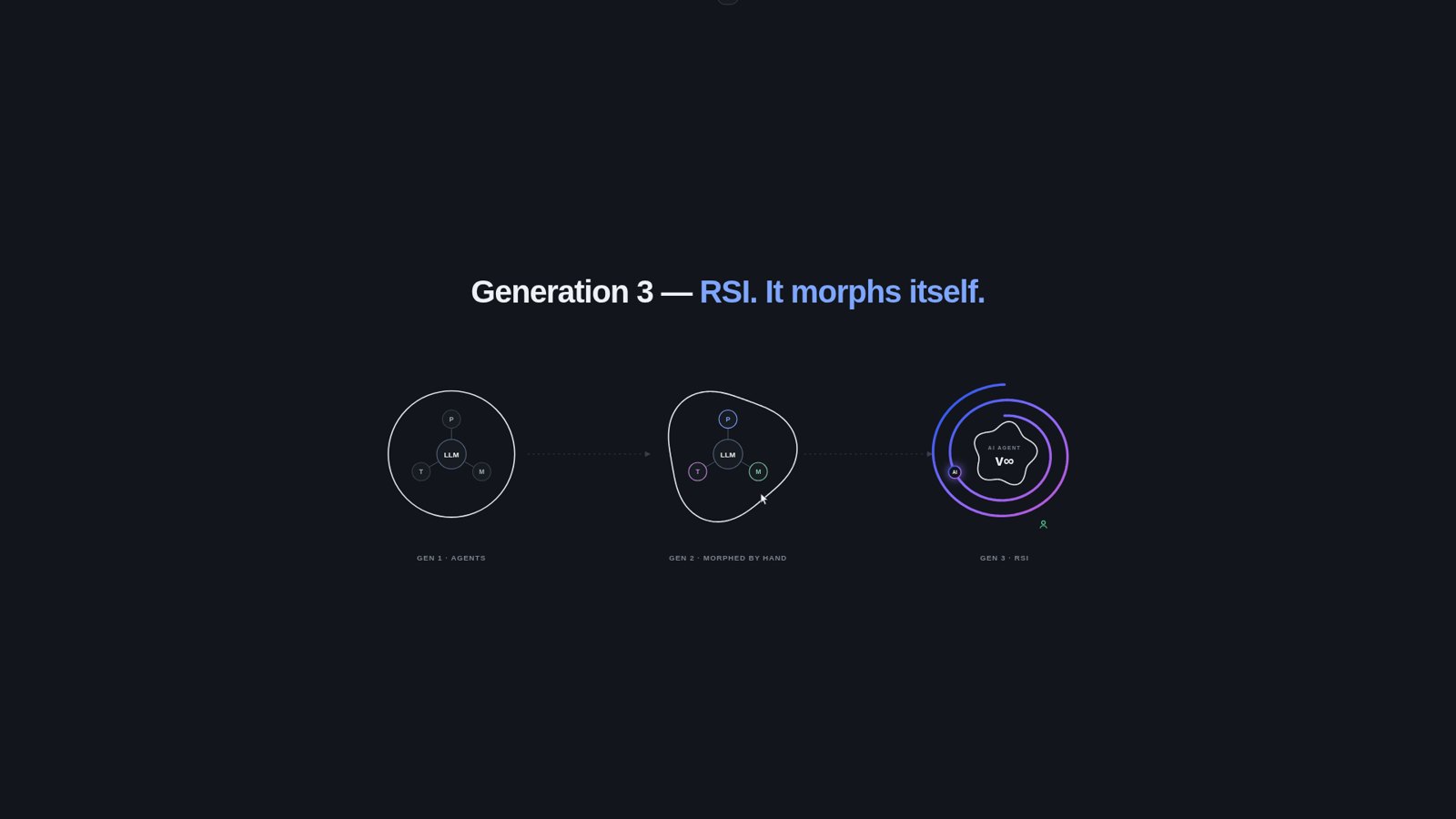
- Generation 1 — AI agents. A model, prompts, tools and memory, set once.
- Generation 2 — morphed by hand. The same AI agents, improved by people, one edit at a time.
- Generation 3 — RSI. The AI agent morphs itself inside a governed loop, with a person approving every change.
Case one improved a customer workflow. Case two improved the operating system beneath the AI voice agent — the model route, the detector, the evaluations, the operational memory, the recovery policy. Together they show why RSI is larger than prompt optimization.
We think about it in three levels. A better answer helps one caller. A better successor AI agent helps every caller who comes after. A better improver compounds the rate at which the next verified improvement can be produced — and that third level is where the recursive effect begins.
Improvement alone is not enough. The system must also reduce the human review, elapsed time, compute and operational risk required to produce the next improvement. We call that Recursive Leverage.
Where this goes
The future will be built by AI systems that learn from production, create verified successors, and keep improving while customers remain in control.
That is recursive self-improvement in production. That is auto-AGENTS™ RSI.
Production figures are reported results from live enterprise deployments. Customer identities, phone numbers and AI agent names are anonymized; screens shown are from an anonymized demo environment reconstructed from production behaviour.